Showing posts with label sustainable. Show all posts

Thursday, March 25, 2010

Our Local Family Farm

Last year I frequented several farmer's markets. I learned a lot about the need for local family farms after reading Michael Pollan's In Defense of Food and after seeing them week after week, I became rather familiar and friendly with them. It was a really beautiful routine: every Saturday, we would throw Aoife on our back, grab a couple of bags and walk through the farmer's market. Sometimes we would buy a fresh pastry from a local baker or a locally roasted cup of organic coffee, but it almost always included buying our eggs, dairy, (sometimes) beef or chicken, fresh herbs and browsing the farm tables for that week's produce that was picked fresh that morning.

One little stand I particularly liked was that for a goat's milk soap offering. Tasha's Own was the name of the sign in front and week after week I would walk up and smell the really amazing essential oils that came from the neat stacks of bars. One week there was a stack of newspaper articles and following the encouragement of the lady standing at the table, I put one in my bag to read later.

Having located my farmer's market late in the season, I was too late to invest in their CSA, but the article detailed about the goat's milk soap, their goat share, the beginnings of their organic farm and investing the time to teach our children about food and raise a community of people who want to do likewise. I was hooked.

The next week, I put my name on their CSA waiting list. I thought that was the end of it.

The summer ended and fall came, winter came and then my phone rang. Did I still want in? Yes: to the organic CSA, the goat share, and a large stack of really fantastic smelling soap. They had just opened up their CSA list for the season and as Joshua and I had just found out we were expecting, we were only too delighted to know we were going to be getting organic local produce all summer long!

Since we signed our CSA and goat share contracts, we've fallen in love with our local family farm. Joshua went up to hold milk bottles for the newborn sheep and goats, help mend horse fences, and learn about modern homesteading. Aoife loves the animals, especially the dalmatian Great Danes, the guinea hens, the barn kitty and lots of running room! I love the long drive into the country to pick up the creamiest milk imaginable, the warm hospitality and the incredible sense of community.

The hardest part of being connected to our local family farm is driving away. Aoife can't bear the thought of leaving the "puppies" behind, Joshua loves getting his hands dirty and doing work he can actually see the results of and I am still wanting to sit, drink tea and learn all the incredible knowledge that can be gleaned from a mama with eight children who makes her own cheese, homesteads her own farm, homeschools her sweeties and still looks lovely doing it all. (I would move into the barn if they'd let me!)

Don't know where to start finding your local family farm? Check out Local Harvest to jump start your search for farmer's markets, farms, locally-sourced restaurants and co-ops.

Live in Tidewater? Check out Pungo Naturals, Mattawoman Creek Farm, New Earth Farm, and Weeping Radish Eco-Farm for organic favorites!

Wednesday, July 15, 2009

Pick Your Own: Blueberries


It almost seems natural now, this is the fifth pick-your-own weekend I've shared with my family and it just seems to be a very normal way to bring in our relaxing Saturday morning. We wake up, brew a little organic direct-trade (or free trade if we run low of the good stuff) coffee, serve up a little fruit, pack up the sweetheart, grab our reused plastic containers and drive out to the farm. This last weekend was open season for blueberries so we went to Pungo Blueberries who we found on PickYourOwn.org and happened to have beautiful bushes ripe for the picking. When we drove up there were already about a dozen people in the front fields and there was an attendant directing traffic (to me, never a good sign... I like quiet farms and empty parking lots. Makes me feel like I found it on my own and I'm the only person who knows about it. But I do acknowledge that empty parking lots don't keep farms open, so I'm glad I wasn't alone). I was nervous that the berry bushes would already be picked over but when we got all saddled up and over to the grove, we were really surprised how easy the picking was.The berry farm is only open four days a week and since the farm is open on both Fridays and Saturdays, the attendant was rather surprised we still made out with five pounds. We actually left earlier than expected (after only about forty minutes), Aoife had been woken from her nap to go out to help us pick and well, she wasn't happy about it.

The grass between the lanes was freshly mowed and the dew was still on the leaves when we went out to pick. I was initially a little concerned about the bushes, because I was finding absolutely no fauna. Read here: no bugs. None. Not even little, tiny, I-missed-the-pesticide-plane bugs. We eventually started to see dragonflies and beetles, which allayed my fears about the amount of herbicides and such that were being used, but I still washed our produce very thoroughly.
The plants had perfectly ripe blue-black toned blueberries, red, pink and green as well, indicative of future growth into the picking season. I appreciate coming early in the season and having first pick. The bugs and birds haven't discovered the ripe and rotted fruit on the ground and the bushes aren't beaten and fields aren't trodden bare from crowds. There's something terribly amazing about a pick your own produce experience. For Joshua and I, as urban homesteaders, connecting even on this basic level with our food helps me to feel like we are doing a small step in the right direction.

Instead of my food being picked (usually unripe, so it arrives ripe--or worse yet, picked ripe and then sprayed with a preservative to help it to maintain its ripe state), boxed, sent to a processing location, unboxed, sorted, packaged, labelled, reboxed, put on a truck, put on a plane, put on a semi, dropped at a distribution location, put on a truck, dropped at a warehouse, put on a produce truck, brought to a store, placed on a display in a stale grocery store under fluorescent lights, waiting until it starts to get bad so they put it on "manager special" status and then thrown in a plastic bag and brought home in a car and shoved to the back of the fridge...

Instead of all that, I can take my family to a farm, pick it myself, laugh with my husband as we listen to ornery old female sisters relate stories of their youth in Sandbridge, teach my daughter about fresh fruit and eating in season and I can place my fresh picked, ripe fruit in reused containers, paying below market cost and enjoying that day the fruits of my labor (no pun intended).

Sunday, July 12, 2009

Cement Gardening

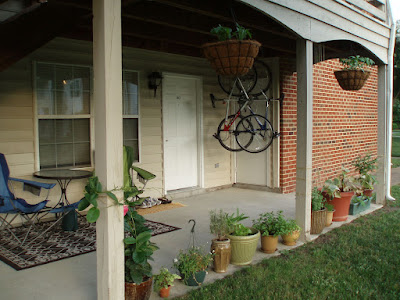
Joshua and I have a little apartment attached to our collegiate institute. We really like the idea of having a garden and being able to grow our own food. Of course, having a cement deck does not really help our plight. When my mom came to visit in May, she helped me get the ball rolling with getting plants and seeds in the pots and helped me get a system going.
It's been almost two months now and I thought it was definitely high time to show the progress that has been made. Here's our little cement-deck shot. We live facing a youth sized soccer field that is encircled by Virginia's favorite tree: the Crape-myrtle.Already planted at this time (early June) were our tomatoes, herbs: (Italian basil, oregano, chive, sage, mint), lettuce, cucumbers and seeds were in the ground for our spinach, dill, peas and radishes.I don't think I've ever gotten anything to grow successfully from seeds and these little beans were giving me some serious hope for my future as a green thumb. I bought these seeds from the farmer's market from a local farm and I was so tickled when they started sprouting early! Two weeks later, my beans were looking for somewhere to grow:
Somewhere in those two weeks, I was feeling pretty good about seeds, so I also planted Italian flat-leaf parsley. Such sweet little green blooms of life:My mom planted my cherry tomato plant when she visited in May and it has done nothing but flourish. I put it at the end of my walkway and it gets excellent amounts of sun in the morning and throughout the day. I have neighbors who planted inverted tomato pots (I'm still not keen on the idea) and had a rocky start with it, but have finally started forming fruit. I've already been harvesting mine for a couple of weeks. Check out the growth on these tomatoes:After two weeks, it had already grown over the top of the tomato stake and was looking for more room to grow.Then one morning after my walk I noticed it was full of blossoms and one tiny little green tomato! I was so tickled, I had to take a photo for posterity.No sooner have I uploaded the photos from my camera when I find that my tomato plant is really growing and I have a beautiful cluster of fruit beginning to ripen!One week at the farmer's market I noticed they were selling plants, of which I had already planted most of the basics, but I saw they were offering lettuce. I had sown seed for spinach and a spring mix, but I thought perhaps this "deer-tongue" variety might be fun to try. The six-pack of lettuce plants was being sold for $1.50, so I figured if it bombed, I didn't lose much. They were looking a little tender and I was rather apprehensive whether I thought they would actually take root, but about a week later, I was already harvesting leaves for sandwiches and to accompany salads.Shortly thereafter... they really started to take off. I went on a trip for two weeks and a couple of my plants died from the heartbreak of my absence, but the lettuce plants that did survive did really well. Also, the spring mix of micro greens I planted by seed in the center of the pot were progressing way beyond my meager expectation of my cement garden.Below is the photo I took this evening of my crazy lettuce plants. Yes, they have gone to seed because I can't harvest their sweet leaves fast enough. I'm hoping to dry out the seeds after it goes wild so I can try my hand at deer-tongue lettuce again. It was such a wonderfully mild lettuce and for our climate and sun, grew extremely well.


The cucumber starter plants I bought I thought would never reach maturity...
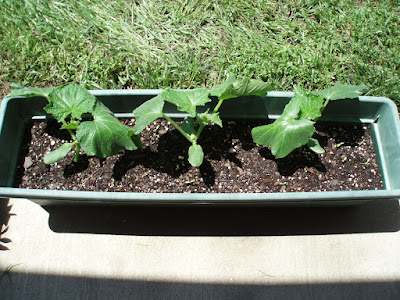
...but those words were barely out of my mouth, when my cukes were already reaching out of the box. I quickly learned that cucumbers have really extensive root systems that bury themselves at least 18" and I needed to transplant even though they had already begun to flower.The transplant was a success and my plants were quickly covered in pretty yellow blossoms and fantastic looking cukes!As far as herbs are concerned, my oregano, chives and rosemary came back from the years' prior, and we purchased starter plants for the Italian basil, purple sage and grew parsley from seed. Now isn't that a fantastic looking herb pot?
I have this special love for Kentucky Colonel spearmint. Just after I got married, my dad had a layover in Norfolk before he flew to Iraq and as my own husband was deployed elsewhere, I had this really special daughter-daddy time where I made him lots of fresh mint iced tea. Somehow I always associate bright, fresh, huge Kentucky Colonel mint leaves with that memory and I love having it on hand in case he should happen to drop in, I have plenty on reserve for him!

This is my purple-leaved sage as of tonight. Joshua and I really enjoy frying sage leaves as a fantastic amuse-bouche styled appetizer. It's so remarkably fresh and clean on the palate and it's rather unexpected... I can't wait to preserve it for the winter and have on hand for our Thanksgiving turkey. For as long as I can remember, my mom has put sage leaves under the skin of the turkey with stems of chives, to look like growing plants under the skin... it makes a wonderful presentation after the bird is browned.

This is my sweetie rosemary plant. I've had the same plant now for three years and though it never seems to get amazingly large, it has been very resilient to the changes (4 different pots, 3 different locations, droughts, floods...). Rosemary is most certainly Joshua's favorite plant in our garden (just ask our friends), so I make sure to take extra care with this plant!

We planted zucchini and Brussels sprouts as well this year. I think they got a late start and were not potted in enough soil (part of the drawback of having to put everything on a cement deck), they both are rather floundering this year and though the zucchini continues to produce gorgeous orange blossoms, I have yet to see fruit.

We also planted bell peppers and jalapenos. The jalapenos blossomed and produced fruit first and are almost ready for an initial harvest, which tickles me because I have a great recipe for preserved peppers that I'm dying to try out!

Speaking of preserving, after my cucumbers were done, I transplanted my Italian basil to the cuke pot and they have really dug deep and grown large enough to start me thinking about caprese salad and pesto!

Of course no garden is complete without it's wildlife and Aoife and I have been able to see many stunning butterflies, moths and dragonflies frequent our garden space. But this one takes the cake. I only saw it once climbing on my tomato pot and then I didn't see it again (I'm sure metamorphosis is to take credit for that), but I still have no idea what it is. Any clues?

The dipledenia I killed from last year was replaced with this gorgeous beauty which I can see from my kitchen and I absolutely love. My mom and I have this kindred relationship for dipledenia and I don't remember ever not having one... the climbing aspect of this flowering shrub just captivates me.

I have so many blossoms on it now it has been such a refreshing scent on my porch and a wonderful spray of pink for the Davis ladies who desperately need something girly!
Thanks for sitting with us on our porch... if you stay awhile, I'll be sure to mix up a tall frosty glass of rosemary lemonade or minty iced tea!
Monday, June 22, 2009

Found: Mulberries

I found wild mulberries while walking with Aoife. It made me do a double take… are those really the mulberries of famed nursery lore?

Here we go round the mulberry bush,
The mulberry bush, the mulberry bush,
Here we go round the mulberry bush.
On a cold and frosty morning.

This is the way we wash our hands,
Wash our hands, wash our hands,
This is the way we wash our hands,
On a cold and frosty morning.

This is the way we wash our clothes.
Wash our clothes, wash our clothes,
This is the way we wash our clothes,
On a cold and frosty morning.

This is the way we go to school,
Go to school, go to school,
This is the way we go to school,
On a cold and frosty morning.

This is the way we come out of school,
Come out of school, come out of school,
This is the way we come out of school,
On a cold and frosty morning.
At any rate, I tipped my hat to Michael Pollan, kept watching the tree to wait until they were ripe, then brought Joshua out with a bucket one evening and we went crazy! Mulberries are white when they are first forming, then they turn pink, red and finally a deep blackberry-purple. Of course, I had to do a little digging online to make sure the leaves and fruit matched up with an edible fruit, since Aoife is still nursing I wanted to make sure I didn't consume something poisonous.
A quick Wikipedia search confirmed the leaves, bark and fruit development to be mulberries and safe for eating. Joshua and I picked almost two quarts of mulberries and after much rinsing, we drizzled on a little honey (from Peace and Plenty farm in North Carolina) and amazing half and half cream (from South Mountain Creamery from Maryland - it's rBgh free and they do not regularly treat with antibiotics. We're buying into a cow share soon, but for now our farmer's market offers SMC's buttermilk, whipping cream and milk and we really love the flavor!). We couldn't believe how fantastic our berries were and can't wait for the wild black raspberries we found to ripen (more on that later).

Monday, April 13, 2009

Green Holiday: Easter

In my efforts to start eating more locally, I built a holiday menu that was seasonal, local, organic and almost entirely homemade. In efforts to reduce waste and reduce our carbon footprint, I purchased almost everything at the farmer's market with my reusable grocery bags and produce bags and utilized cloth napkins at the table. Here's a listing of our SOLE food Easter menu:

Eggs Benedict:

Crepes Suzette:

  • Local duck eggs (also from Peace & Plenty farm in NC)
  • Locally produced cream (from Homestead Creamery in Roanoke)
  • organic butter
  • domestic flour (from King Arthur in VT)

Blanched Asparagus:

  • locally grown and harvested asparagus (purchased at the Eastern Market in Capitol Hill)

Chocolate Truffles

  • locally made chocolate truffles that are made without additives or preservatives using only seasonal ingredients (bought at 5 Points Community Market from Cocoa Noveau: she recently set up an Etsy store so when she bakes for the farmer's market you can purchase her fantastic European chocolates online!)

My only regret was that I didn't take a photo of us enjoying all this fantastic food!!

Thursday, April 9, 2009

Patio Garden

It's almost time to start planting. This weekend I'll start turning my dilapidated deck space into my garden. This year will be a little different since we moved during the winter and our new apartment is completely westward-facing. (Read here: only afternoon/evening sun... almost entirely useless for growing vegetables). I have not yet begun researching plants that will be more accommodating to part-sun and shade since I really just wanted to plant cucumbers, tomatoes, carrots, beans; all of which are sun-lovers. I have half a mind to plant them in my studio on top of my architect's desk, which would ensure that no pests reach my plants but would also inhibit pollination of the fruit later which would likely pose a problem, at least for my tomatoes.

My rosemary, chives and oregano are already back from last year and are excited about this new season. Our new apartment is on the base floor and is completely sheltered from the rain which also poses an issue for growing. Rosemary is from the arid mountainous terrain of Italy and does well in dry soil but chives and oregano do not. I've started running outside when it rains and pushing my little window boxes into the rainfall so they may get some of the free nutrients but my dipledenia and hibiscus from last year aren't even budging.

This year, Joshua and I have talked about planting lettuce and scallions, both of which would go really well in the large pots that are currently hosting my dead (am I already pronouncing that?) dipledenia and hibiscus plants. My mom may be journeying this way next week and perhaps dirt digging will be a quality mother-daughter activity. Last year my mother planted my garden alone. I was nine-months' expecting and we were biding our time until Aoife came, so I kept her company while she planted all my flowers and herbs.

I won't lie: I cannot successfully grow anything from seed. I buy seedlings and small plants because my green thumb was amputated at a young age: I believe in kindergarten I grew marigolds and that may have been my last successful venture.

I am undecided from where I will purchase my plants this year. Traditionally, I buy them from the McDonald Garden Center, but this year I was thinking about purchasing from something a little more "grassroots". Our local community college has a horticulture club that is sponsoring a plant sale, including a nice list of herbs and vegetables, all of which seem to be well researched for hardiness and resistance to disease. The other location is my local farmer's market: Five Points Community Farm Market which is sponsoring the sale of starter plants. Last weekend while in Washington D.C I went to one of my favorite farmer's markets: The Eastern Market at Capitol Hill. The purple Thai basil and lamb's ear sage they were offering made me wish I lived closer!

I'll post before and after pictures of my deck so you can see how I'm transforming the space into something edible, enjoyable and sustainable. In the meanwhile, I'll start resarching a type of tomato that grows in the dark in dry soil...

Monday, March 30, 2009

SOLE Food

No, I didn't spell that wrong. I meant SOLE food: Sustainable-Organic-Local-Ethical.

I have started really jumping into the green food movement. Joshua and I routinely shopped at the local food market and though we have been making a pull away from processed foods for awhile and try primarily to eat whole food sources, I was not making a large distinction as the origin of my food.

Across the street from our previous residence was an organic foods market that offered a really great selection of items both produce and packaged, but I did not capitalize on it since I was buying cheaper items at my local grocer. However, I picked up a book recently I bought for my pregnancy and was instantly compelled by the statistics it offered on the differences between conventional and organic foods. First, let me say that some conventional farmers utilize organic practices but have not invested for the organic conversion and as such these statistics are not hard and fast.

The buzz about eating food locally has even hit the White House, as this week the First Lady begun planting a 1,100 sq ft garden, to help her daughters learn about the importance of eating healthy, fresh and emphasizing locally grown produce.

Saturday, Joshua and I found a great new farmer's market that spring-boarded my research and understanding of SOLE food. I landed a copy of edible Chesapeake, a quarterly magazine that focuses on local food in its season. This concept in itself has been hitting me hard lately. I went to the grocery store last week and in my cart as I was checking out I noticed a couple of things: grapes, pineapple, watermelon, bananas and avocados. I suppose this would not be an issue if it were July and I lived in Central America, but as it stands, these items travelled a long way to end up in my cart Saturday afternoon. The imported grapes are definitely on the worst conventional foods list, aptly named the "Dirty Dozen" as they are the twelve most pesticide-harboring fruits and vegetables. When I visit my parents in Waikiki this October, I'll make sure to load up on tons of fresh pineapple and bananas, as they will be there in abundance and I know I can wait a couple of more months for fresh watermelon at my farmer's market. Avocados will definitely be put on my cereal when I get to Florida next month as my mother in law has recently sparked a new affinity for them. I need to start eating produce in its season.

A girlfriend of mine recently also started me on the ethics of eating meat. I used to think PETA was just a little off-kilter ranting about (what I thought to be) isolated events of harm to animals. Research is pouring in about the wide scale effects of slaughterhouses and factory farms--its detriment to the environment, economy, our health and the welfare of the animals who are living there. An article was recently written on the Muslim butchering method called halal:
In order for meat (except pork, which Muslims don’t eat) to be halal, which
means lawful, a Muslim has to say a blessing, position the animal facing
toward Mecca, and slaughter it with a swift cut across the throat with a
very sharp steel knife. This centuries-old method of slaughter, similar in
many ways to kosher slaughter, is meant to incur the least pain possible
while allowing the carcass to be completely drained of blood... halal rules
include several provisions for minimizing the animal’s stress prior to
slaughter, including ensuring it has been normally fed and watered, and that
it is in good health, and prohibiting any animal from seeing another animal
being slaughtered. And if they have traveled, they are required to be well
rested—at least overnight—before slaughter, according to Egyptian-born Omar
Wali, owner of American Halal Meat in Springfield, Virginia.


Reading these articles really makes me reconsider some of my food choices and
makes me want to take a more conscious approach toward how I consume.